













For the billions on TikTok and Instagram, the barrage of influencers with thin bodies is inescapable.
“Thinfluencers” are gaining popularity in a climate where body positivity culture has rapidly lost momentum. Criticisms of the body positivity movement have always been simmering below the surface, with claims that it promotes unhealthy lifestyles in the name of inclusivity and glamorizes obesity. In recent years, these criticisms have become vitriolic. Beauty standards in this post-Postmodern era of digital media are complex. And yet, one thing stays the same: it is unattainable.
Models with “Instagram face” dominate our screens, undisclosed plastic surgery is abound, and extreme diet and gym culture are often the norm. While the 2010s saw a surge of influencers and celebrities with bigger bodies, in the 2020s there’s been a shift. Instead of the impossibly curvy bodies and big facial features, there is a trend towards the delicate and small.
Teri Hofford is a photographer and educator who is deeply interested in body image and identity. As a millennial, she is no stranger to diet culture. Television and magazines were the messengers of the time, but the message itself was no different. When it comes to the narrative on social media, she says, “Even if you’re not actively engaging in what you’re seeing when you’re scrolling, your brain is taking note of what you’re looking at.” The struggle against the erroneous belief that thinness equals health is arduous and frustrating. When you see someone skinny on social media in athletic wear, Teri says, “[your] brain’s going to say, well, that’s what health looks like.”
“When we look at ourselves, our bodies don’t represent our bodies. Our bodies represent everything we know about ourselves.”
Her work began as a series of happy accidents. A women’s studies class here, a job at a weight loss company there. She started photography in her 20s and noticed how people would react to being photographed. Sometimes, there was noticeable nervousness around a certain body part like the stomach or the arms. For some time, she worked around her clients’ insecurities. She says, “What most people want for their first photo shoot… is just to see that they can look like the beauty standard.”
Eventually, she came to the realization that helping people “meet” the beauty standards wasn’t the same as celebrating their diverse and unique bodies. She collaborated on a project photographing the trans community in Winnipeg where many of her subjects were non-binary. Her work truly shifted when she realized that there was an innate bias in the way she approached photography. She realized, “Oh no, I have rules for how to pose a woman and how to pose a man. I had forgotten how to pose a human.”
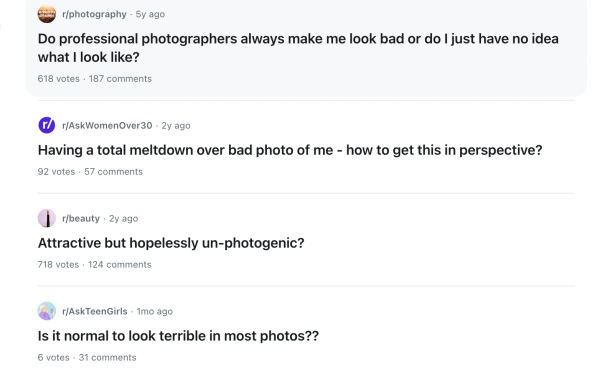
A quick search online will reveal exactly why her photography resonates with people. There are countless posts on Reddit with titles like “Why do I look so bad in photos?” and “How can I be more photogenic?” Many of those posting and the commenters sympathizing with them admit that they have stopped taking photos for fear of looking ugly. They avoid pictures on special occasions and miss documenting moments with loved ones because they hate the way they look on camera. As a photographer and as a human, Teri thinks documenting life is important. She believes in being part of history. “It’s one of the ways we can make ourselves infinite in a finite life.”
According to her, the irony is that the more you look at photographs of yourself, the more comfortable you will be seeing yourself. When you’ve seen every angle countless times, it’s less of a shock for your brain when perceiving your body. You may not meet the beauty standard but you can look joyful or fashionable in a photograph.
Fortunately, Teri has practical steps to go along with her advice. She calls it the ACE method.
A is Awareness: When you see a photo of yourself, recognize the thoughts, feelings or behaviors that accompany it without trying to change them. Are you anxious? What are you afraid of?
C is Curiosity: Explore those feelings without judgement. Ask yourself what it would mean if your fear was true. Consider the source of the thought. Where did you first learn that belief?
E is Empowered and Embodied Action: Choose how you will respond. Do you want to be more present in photographs? Do it with a new understanding of your thought process. The purpose is to ask questions. Teri suggests asking yourself: Where did I learn that? Do I know it to be true? And who profits off me thinking that way?
As our algorithms get more and more specific, it’s worth asking what the constantly changing standards are doing to our self-perception. Botox and Ozempic have changed our idea of what is normal. Children are worrying about aging and makeup at ages when none of that should matter. We may have circled back to 90’s beauty standards but with the cogs of capitalism increasing tenfold. Curating our feeds is no doubt important but Teri says there is no substitute for face-to-face interaction when it comes to seeing diverse human bodies with unique personal experiences.
However, it’s easy to let in judgement for yourself even when you have grace for others. “When we look at ourselves, our bodies don’t represent our bodies. Our bodies represent everything we know about ourselves.” Teri says if there’s one thing that she wants people to remember, it’s that: “We are a whole person… which tells me that if I can love one part of me, I can love another part of me.”

